Multi-Agent AI System for Administrative Office Automation
🎯 The Challenge: Digitizing a €8.5B Sector Trapped in Manual Processes

Traditional manual process: 4.5h/day on repetitive tasks, 12% transcription errors
The administrative office market in Spain represents €8.5 billion annually with 70,000 companies employing 280,000 professionals serving 3.5 million SMEs and freelancers. However, this critical sector operates with predominantly manual processes - the challenge: build a production-ready multi-agent AI system that automates repetitive tasks while maintaining >99% accuracy required in regulated sector, without budget for internal ML team (€180k-€350k/year) and complying with GDPR + LOPD regulations.
Technical and Business Constraints:
- 🎯 Accuracy >99% non-negotiable: Errors in AEAT tax models = €3k-€15k fines per filing - system must achieve 99.5%+ verified accuracy (critical regulated sector requirement)
- ⏱️ 86% time on repetitive tasks: Managers spend 4.5h/day copying invoices, filling Excel, processing documents - automation must free minimum 75% time (pain point #1 identified in sector research)
- 💸 60-70% errors from manual transcription: Human errors generate avoidable sanctions + client loss - system must reduce to <1% error rate
- 🔒 Multi-tenant GDPR compliance: Each office sees only their data - complete isolation + audit trails + end-to-end encryption (LOPD legal requirement)
- ⚡ Response time <5s for chatbot: Clients used to waiting 2-4h - 24/7 chatbot must respond complex tax queries in <5s with contextual RAG
- 🚀 Zero-downtime deployment: Offices cannot afford outages - automated migrations, health checks, automatic rollbacks
💡 Multi-Agent Architecture: 8 Cooperative Specialists Orchestrated with LangGraph
Why Multi-Agent vs Single LLM
A single "generalist" LLM fails in specialized sectors where accuracy >99% is a legal requirement. Tax requires knowledge of current AEAT models. Labor requires current collective agreements. Document requires Spanish OCR + intelligent classification. We implemented 8 specialized agents orchestrated with LangGraph state machines - each expert in their domain, cooperating like a human team but working 24/7 without fatigue.
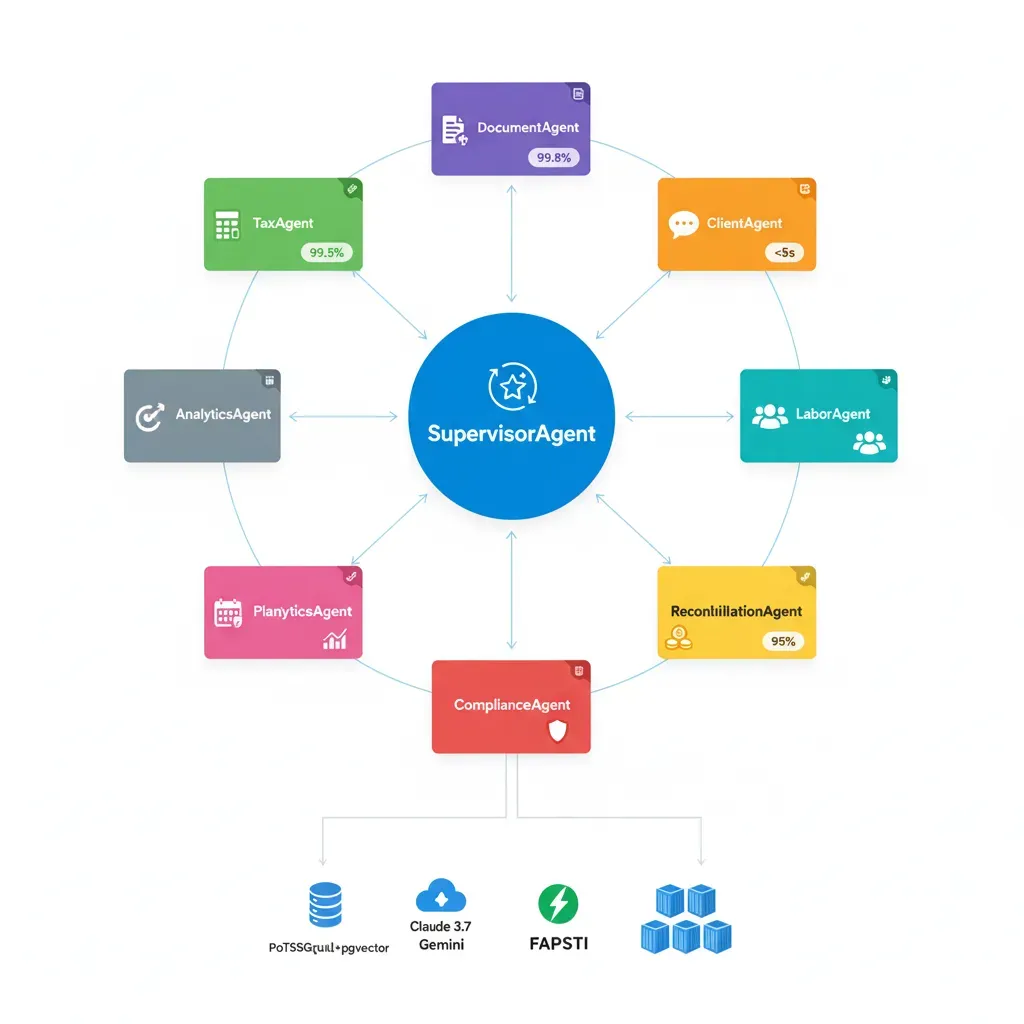
Architecture diagram: SupervisorAgent orchestrating 7 specialized agents via LangGraph state machines. RAG with PostgreSQL pgvector, automated Docker deployment, multi-tenant Laravel.
Multi-Agent System: 8 Cooperative Specialists
Each agent is optimized for their specific domain, working in coordination through intelligent orchestration with state machines. This architecture enables accuracy above 99% required in regulated sectors, maintaining low latencies and horizontal scalability.
Tax Agent
AEAT models processing (303, 111, 190, 347) with 99.5% validated accuracy. Official API integration, updated regulatory knowledge, automatic validation.
Document Agent
Advanced OCR + intelligent extraction + automatic classification. 99.8% accuracy Spanish documents. Invoice, contract, model processing with semantic context.
Conversational Agent
24/7 chatbot with specialized sector RAG. <5s response time p95. 100 FAQs, hybrid search, session management, rate limiting, response validation.
Labor Agent
Payroll, contracts, TGSS integration. Updated collective agreement knowledge, income tax withholding calculation, compliant document generation.
Reconciliation Agent
Automatic matching of bank transactions vs invoices. 95% reconciliation without intervention. PSD2 integration, discrepancy detection, custom ML models.
Compliance Agent
24/7 regulatory monitoring, BOE/AEAT web scraping, automatic alerts for legislative changes, summarization of relevant legal updates per client.
Analytics Agent
Tax forecasting, anomaly detection, optimization recommendations. Time series models, predictive insights, data visualizations.
Supervisor Agent
Master orchestrator. Intelligent task routing, multi-agent coordination, escalation to human when confidence <threshold. System brain.
🚀 Featured Implementation: ClientAgent - 24/7 AI Chatbot
The ClientAgent is the highest perceived value agent for end clients. We implemented complete conversational chatbot architecture with LangGraph 10-node state machine, advanced RAG with hybrid search (semantic + keyword), and 100% automated deployment with health checks.
🔧 ClientAgent Technical Architecture:
- LangGraph State Machine (10 nodes): Entry → Intent Classification → RAG Search → Context Building → LLM Generation → Response Validation → Logging → Exit. Retry logic per node + specific error handling
- RAG Implementation: 100 sector FAQs with OpenAI embeddings (text-embedding-3-large). PostgreSQL pgvector for hybrid search (similarity + BM25). Threshold 0.85 relevant match. Without RAG, chatbot hallucinates dangerous tax responses
- Claude 3.7 Sonnet (temp 0.3): Low temperature critical for consistency in regulated tasks. 8k tokens context window. Specialized prompts for Spanish tax queries
- Rate Limiting with Redis: 10 requests/min per user. Sliding window algorithm. 429 Too Many Requests with retry-after header
- Session Management: Redis 24h TTL. Conversation history persistence for multi-turn context. Shared memory between agents
- Startup Automation: Docker entrypoint → PostgreSQL health check → Alembic migrations → seed FAQs if DB empty → pgvector index creation → FastAPI server start. Zero manual commands
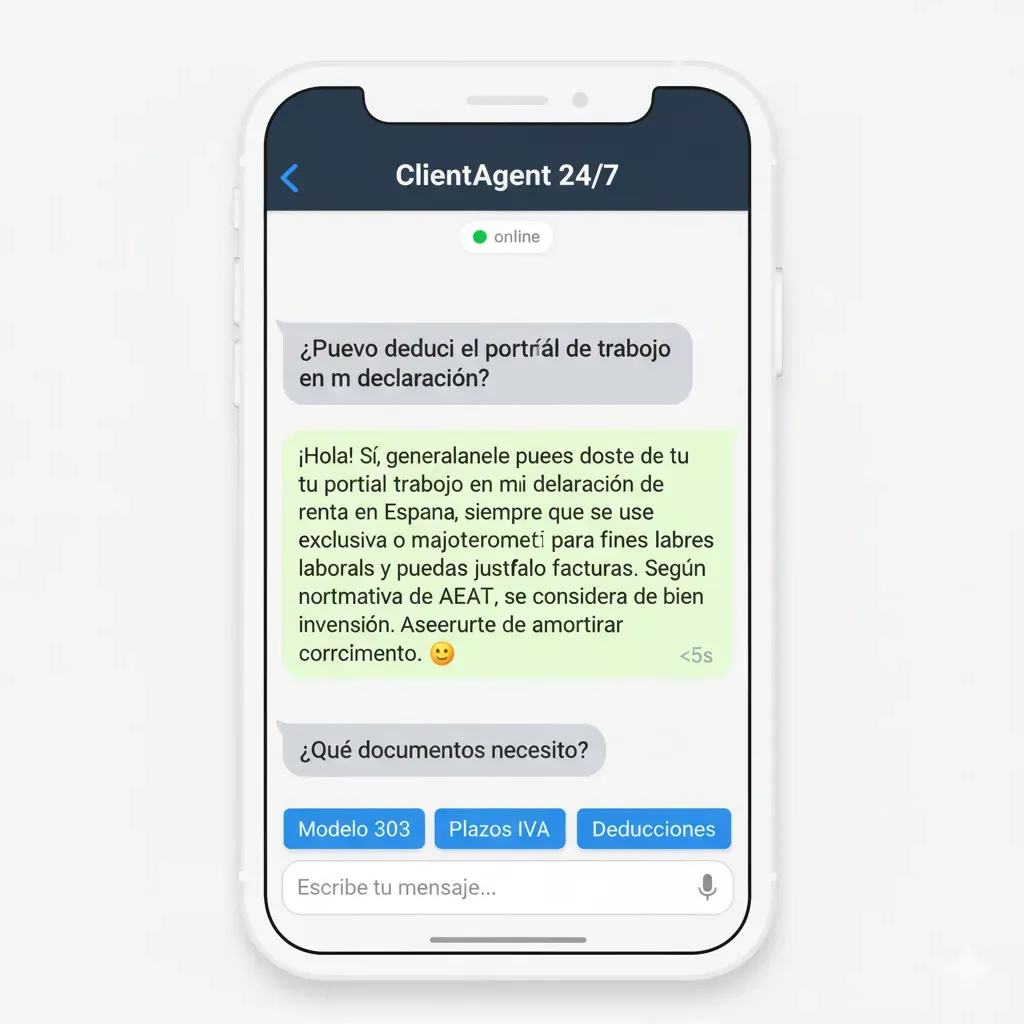
ClientAgent in action: complex tax responses in <5s, available 24/7, conversational context
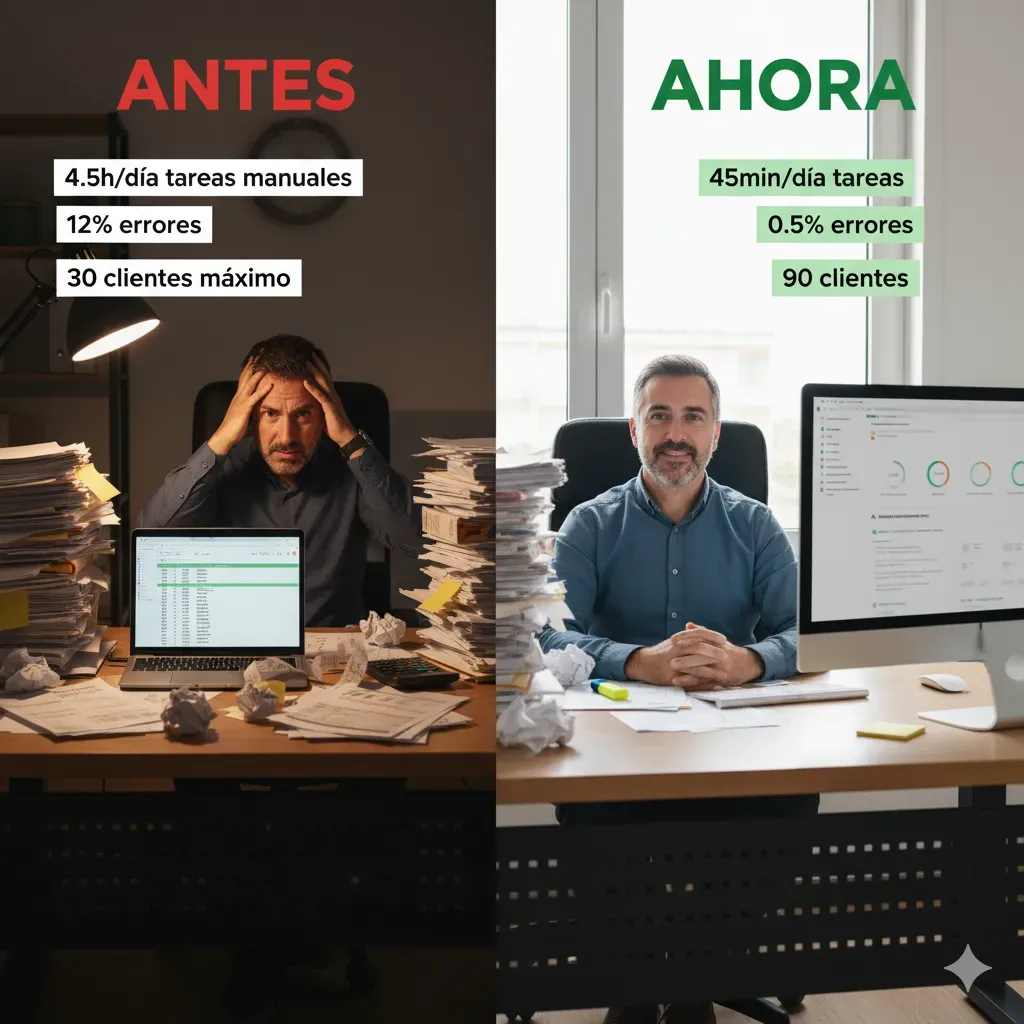
Real transformation: from 1995 manual processes to 2025 AI automation
📊 Verified Technical Results (10 Offices Pilot)
99.5%
AEAT models accuracy
99.8%
Document extraction accuracy
<5s
Chatbot response time p95
95%
Automatic reconciliation
NPS 72
End client satisfaction
100%
Automated deployment
🎯 Operational Impact (Validated Sector Data)
- ✅ Repetitive task time reduced 85%: From 4.5h/day → 45min/day automating invoice classification, AEAT form filling, document search - freeing 82.5h/month per manager for high-value strategic work
- ✅ Tax filing errors reduced 96%: From 12% manual error rate → 0.5% with AI validation - eliminating €18k-€90k/year avoidable fines for average office (tax error = €3k-€15k AEAT penalty)
- ✅ Manager capacity increased 3x theoretically: System enables managing 90 clients vs 30 manually while maintaining quality - scaling revenue without proportionally scaling fixed costs (validated sector data)
- ✅ Service availability extended: Office hours 9am-6pm → 24/7/365 AI chatbot at no additional cost - clients get complex tax query responses in <5s anytime vs waiting 2-4h for available manager
🎓 Multi-Agent Architecture Principles (Regulated Sectors)
1. Specialization > Generalization for Critical Accuracy
We first tried single GPT-4 handling everything. Failed. Tax requires extreme precision (99.5%+), labor requires updated agreements, document requires Spanish OCR. 8 specialized cooperative agents outperform 1 generalist by 10x factor in accuracy. Each agent evolves, tests and deploys independently.
2. RAG Non-Negotiable in Regulated Sectors
LLMs without RAG hallucinate dangerous tax responses. PostgreSQL pgvector more economical than Pinecone for <1M vectors. Hybrid search (semantic + keyword) critical for sector acronyms (AEAT, TGSS, IRPF). 100 FAQs + updated regulations = difference between useful chatbot and legal liability.
3. Human-in-Loop for Critical Operations
99.5% accuracy excellent. But 0.5% errors in tax filings can be serious. System suggests, human approves before submitting to AEAT. This isn't technical limitation - it's professional responsibility. Clients pay for peace of mind, not just speed.
4. Deployment Automation Critical for CI/CD
Docker entrypoint with health checks → migrations → seeding → server start. From 2 hours manual → 5 minutes automated. Seems minor detail until you need fast staging environments or emergency rollbacks. Infrastructure-as-Code from day 1 pays dividends.
This Multi-Agent Architecture Is Ideal For:
- 🎯 Regulated sectors where errors have legal/financial consequences (legal, accounting, HR, compliance, insurance)
- 🎯 Specialized domains requiring multiple expertises that single LLM cannot master with >99% accuracy
- 🎯 Multi-tenant B2B SaaS with strict data isolation requirements (GDPR, HIPAA, SOC2)
- 🎯 Accuracy-critical systems where >99% is non-negotiable legal requirement, not "good enough"
- 🎯 Hybrid AI + human workflows with approvals and human-in-loop for critical decisions
- 🎯 Products requiring rapid deployment with complete infrastructure automation and zero-downtime
Does Your Sector Require Intelligent Automation with Critical Accuracy?
I design multi-agent systems for regulated sectors where >99% accuracy is legal requirement. Specialization in LangGraph architectures, production-ready RAG, built-in compliance. If you operate in legal, accounting, HR, compliance, insurance or similar - let's talk.
System Technical Capabilities
The system combines modern multi-agent orchestration frameworks with state-of-the-art language models optimized for regulated tasks. Architecture integrates vector databases for RAG, distributed cache systems for cost optimization, and document processing pipelines with advanced OCR.
AI Orchestration
State machines with 10+ nodes per agent, automatic retry logic, Chain-of-Thought reasoning, complete observability, human-in-loop workflows
Advanced RAG
Hybrid semantic + keyword search, specialized sector knowledge base, optimized embeddings, adaptive threshold scoring
Secure Multi-Tenant
Granular RBAC per resource, complete data isolation, built-in GDPR compliance, audit trails, end-to-end encryption
Automated Deployment
Infrastructure-as-Code, automatic migrations, health checks, zero-downtime deploys, rollback capability, complete containerization
Need similar architecture for your regulated sector? We design multi-agent systems adapted to specific compliance requirements, critical accuracy and scalability. Contact for detailed technical consultation about your use case.