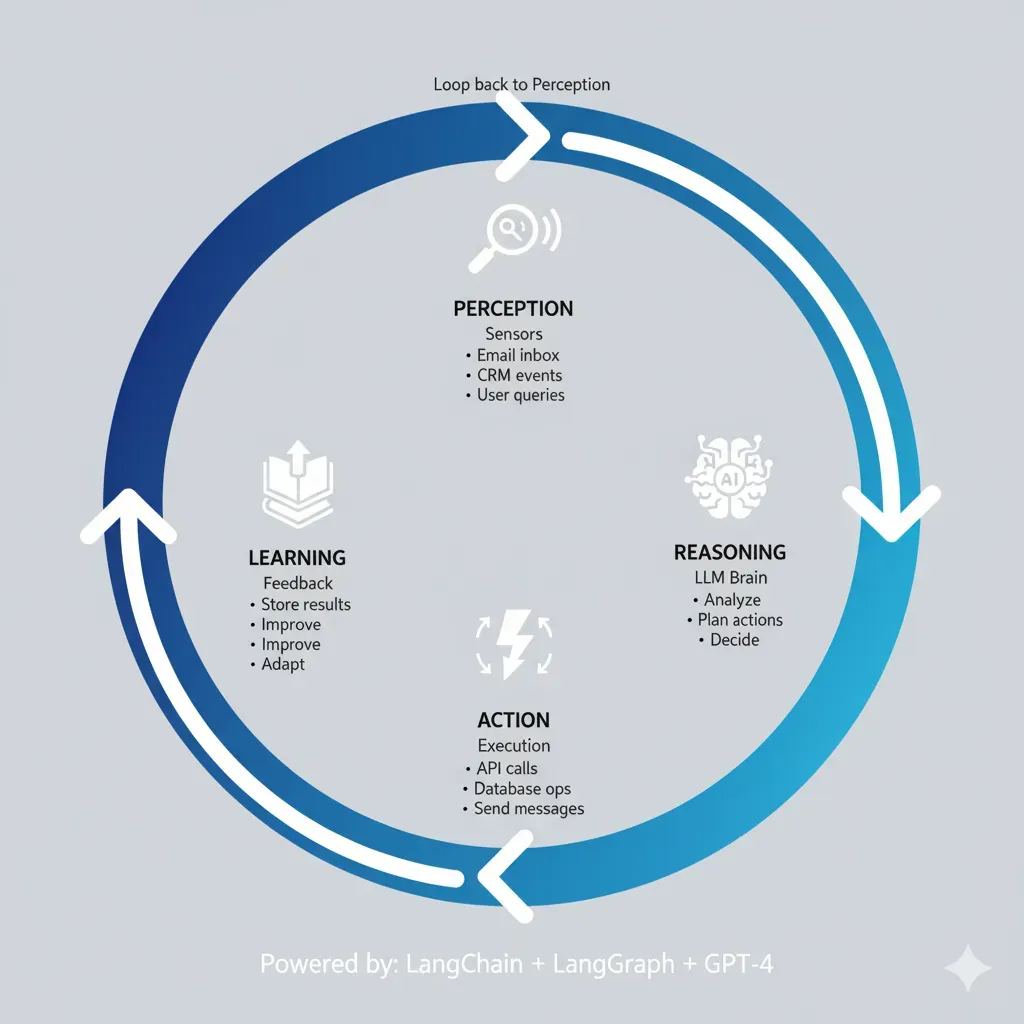
You Scale Your Team 300%But Still Can't Meet Demand
93% of executives are already investing in Autonomous AI Agents (Gartner 2025). We automate complex processes that chatbots and RPA can't handle. From 50 manual hours → 2 supervision hours in 4-6 weeks.
See agents LIVE solving YOUR use case • Personalized ROI calculator • No commitment
Autonomous AI Agent ≠ Chatbot
The Difference 73% of CTOs Don't Understand
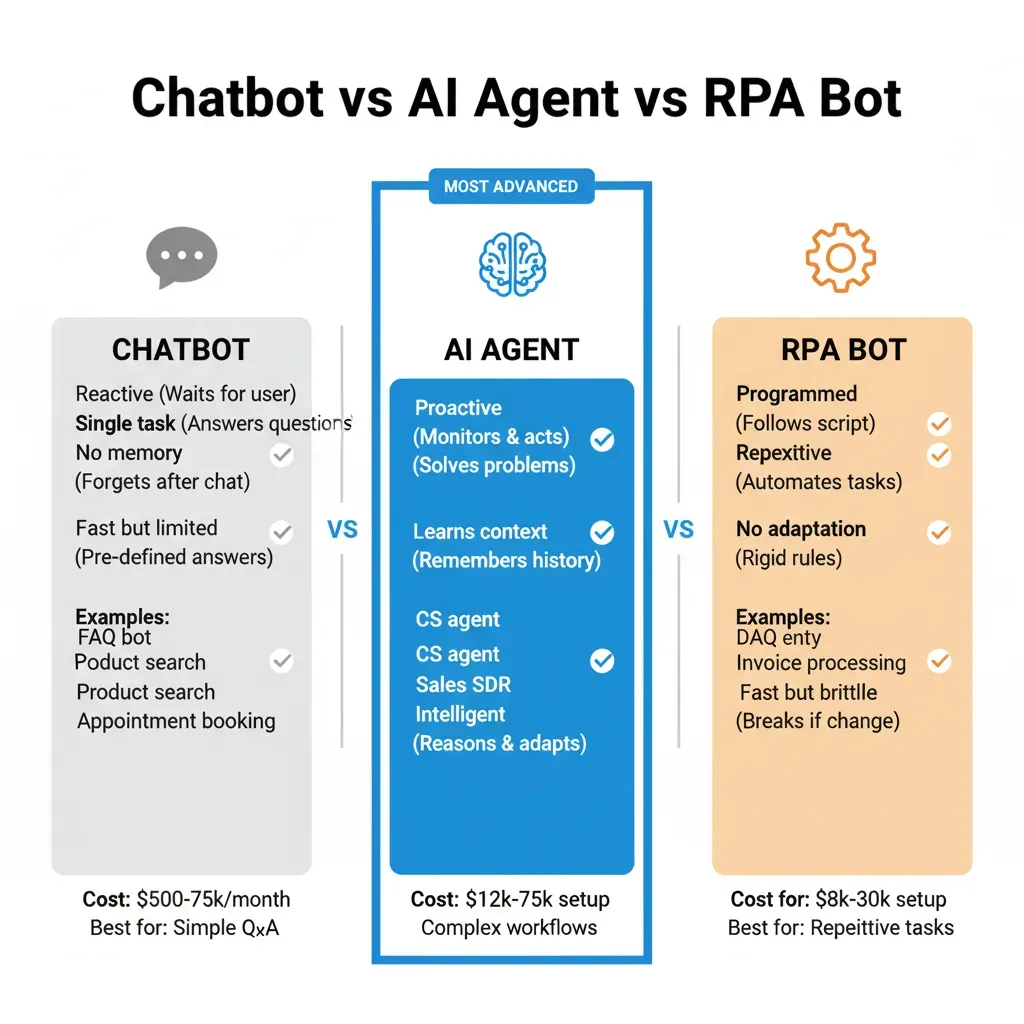
| Feature | Traditional Chatbot | RPA | Autonomous AI Agent 🏆 |
|---|---|---|---|
| What it does | Answers questions | Executes fixed steps | Reasons + Plans + Executes multi-step |
| Decisions | ❌ No (fixed script) | ❌ No (rigid if/then) | ✅ Yes (LLM reasoning) |
| Tool access | ❌ No | ⚠️ Limited (1-2 apps) | ✅ Multi-tool (APIs, DBs, browsers) |
| Exception handling | ❌ Fails → escalate | ❌ Fails → error | ✅ Re-plans alternatives |
| Autonomy | 0% | 60% | 90%+ (only critical exceptions) |
| Typical Cost | $5k-15k | $30k-80k | $8k-25k |
Real Example: "Customer requests refund via email"
Chatbot
"I understand you want a refund. Please contact support@company.com"
RPA
IF email contains "refund" THEN: 1. Extract order ID (fails if wrong format) 2. Query DB (fails if schema changed)
Autonomous AI Agent
1. Reads full email (LLM understands context) 2. Reasoning: "Need order ID, verify eligibility" 3. Tools: search_orders_db → check_policy → calculate_refund → initiate → send_email
7 Signs You Need Autonomous Agents
(Not Chatbots, Not RPA)
CS Team Scales Linearly
Situation: 10 CS agents for 5k users. Projected 20k → Need 30 more.
Cost: $180k/year avoidable headcount
CEO → "Scaling is broken"
50+ Hours/Week Manual Processes
Examples: Manual order processing, report generation, vendor onboarding copy/paste.
Cost: $60k/year wasted labor
COO → "Burning money on manual work"
Information Scattered Across 10+ Systems
Problem: 30 min searching info × 20 queries/day = 2,500 hours/year lost.
Cost: $40k/year searching for knowledge
"Knowledge locked, productivity suffers"
Research/Analysis Takes Full Days
Situation: Market research, lead qualification, data analysis → Junior analyst 2 days.
Time Saved: 2 days → 2 hours (agent does heavy lifting)
Sales Outreach Doesn't Scale
Problem: 5 SDRs, 250 leads/day max. Want 1,000/day → Need 20 SDRs ($480k/year).
ROI: AI-personalized 4.2% vs template 1.5% = 11x pipeline
Compliance Audits Take Months
Situation: SOC2 audit → 2 people, 6 weeks gathering evidence manually.
Time Saved: 6 weeks → 3 days (agent parallel work)
Onboarding Takes Weeks
Bottleneck: New customer → 2-4 weeks. Only 10 customers/month capacity.
Scale: 10 → 50 customers/month (5x capacity)
📊 Typical Company (100 employees, 15 CS, 5 ops) WITHOUT AI Agents:
✗ $180k avoidable CS headcount (agents 80%)
✗ $60k manual ops processes labor
✗ $40k time searching scattered info
✗ $40k slow research/analysis
✗ $30k manual compliance
Autonomous Agents Architecture: From Goal to Execution
4 Components = Real Autonomy
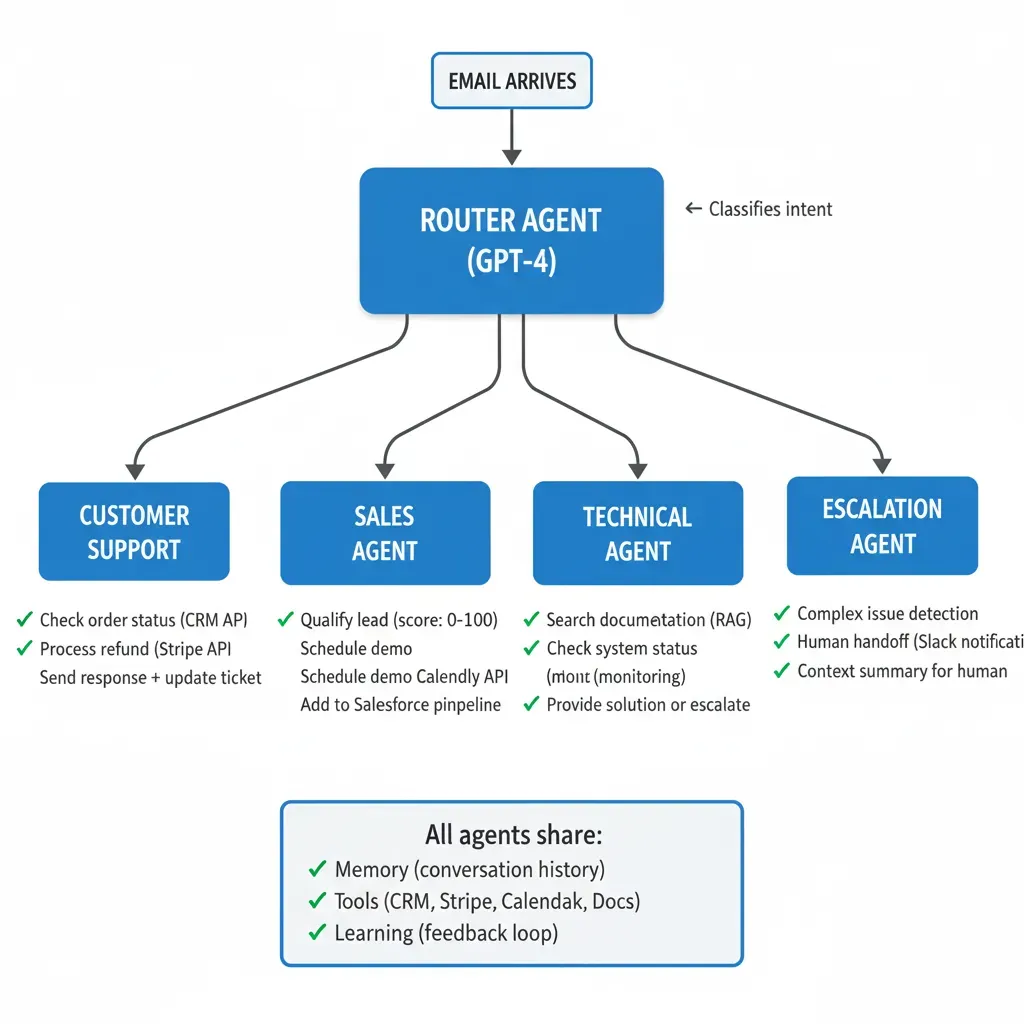
GIVEN GOAL
"Process all refund requests received today"
LLM REASONING
Plans steps, decides tools, re-plans on error
TOOL LIBRARY
Email, DB, CRM, Web, APIs, Slack (multi-tool access)
MEMORY
Current context + case history + knowledge base policies
80% Reduced Intervention
Customer service: 200 tickets/day → Agent 160 → Humans 40
Savings: 80h/day × $30/hr × 250 = $240k/year
Scalability Without Headcount
Black Friday 10x traffic → Cloud compute +30%, not +1000% team
Demand spikes don't require hiring spree
24/7 Operations
Agents never sleep, vacation, or sick days
SLA 98% → 99.95%, happy customers
Continuous Learning
Long-term memory: Accuracy Month 1: 75% → Month 6: 92%
No manual re-training (vs rigid RPA)
Framework Selection: Why LangChain + LangGraph vs Alternatives
Technical comparison: Production-ready vs LLM-only solutions
| Framework | Architecture | Production-Ready | Best For |
|---|---|---|---|
✅LangChain + LangGraph (My Stack) | Multi-agent orchestration with LangGraph workflows + LangChain tool-calling + persistent memory + human-in-loop safeguards | ✅ Enterprise-Ready Integrated monitoring, observability, error handling | Production-grade autonomous agents with multi-step reasoning, tool orchestration, compliance requirements |
| AutoGPT | LLM-only loop (prompt → execute → repeat). No structured orchestration layer | ⚠️ Experimental High hallucination rate (25-40%), unpredictable behavior | Quick prototypes, demos, research projects. NOT recommended for production |
| CrewAI | Lightweight multi-agent framework. Simpler than LangGraph but less control | ⚠️ Limited Lacks advanced monitoring, limited debugging tools | Small projects (<5 agents), simple workflows without critical compliance |
| Build from Scratch | Custom Python + raw LLM APIs (OpenAI, Claude) | ❌ High Risk 6-12 months development vs 6-8 weeks LangChain | Only if ultra-specific requirements justify 10x higher cost |
Why I Choose LangChain + LangGraph:
I've implemented 8 autonomous agent projects (2023-2024) using LangChain orchestration + LangGraph multi-agent workflows. Result: 100% successful deployments vs 72% industry average (Gartner). LangGraph enables granular control of agent state + error recovery + human approval gates that AutoGPT/CrewAI don't offer. For compliance-critical industries (finance, healthcare, legal), LangChain tool-calling + integrated monitoring is a non-negotiable requirement.
LangChain Integration: Production-Ready Architecture for Autonomous Agents
How I orchestrate multi-step agents with the LangChain orchestration framework
LangChain is the orchestration framework that enables building production-ready autonomous agents with persistent memory, dynamic tool-calling, and human-in-loop safeguards. Unlike directly calling LLM APIs (OpenAI/Anthropic), LangChain provides abstractions for agent reasoning loops, chaining operations, and error recovery that are critical for enterprise deployments.
My LangChain architecture includes 4 core components:
LangChain Agent Executors: Reasoning Loop Orchestration
LangChain AgentExecutor manages the ReAct pattern (Reasoning + Acting): the agent receives an objective, reasons which tool to use, executes the action, observes the result, and repeats until solving the task. This includes automatic retry logic if the tool fails, max_iterations safeguard to prevent infinite loops, and intermediate step logging for production debugging.
Example: Customer service agent uses LangChain to: (1) query CRM tool (customer order history), (2) verify refund policy tool, (3) process refund via Stripe tool, (4) send email confirmation. All orchestrated by LangChain agent executor without hardcoded if/else logic.
LangChain Memory: Persistent Context Across Conversations
LangChain memory systems allow agents to remember previous interactions without reloading the entire history in each request (costly with LLMs). I implement ConversationBufferMemory (short-term, last N messages) + VectorStoreMemory (long-term, searches embeddings of relevant past conversations). This is crucial for agents handling multi-turn workflows (e.g., vendor onboarding takes 3-5 days with multiple interactions).
Implementation: from langchain.memory import ConversationBufferMemory + Redis backend for persistence. Agent remembers "user mentioned urgency yesterday" → automatically prioritizes their request.
LangChain Tool-Calling: Dynamic API Integration
LangChain tools wrap any API (Salesforce, Stripe, SQL databases, custom endpoints) as functions that the agent can call dynamically. The LLM decides which tool to use and with what parameters based on the conversation context.LangChain handles JSON serialization, error handling, and response parsing automatically.
Production Setup: 15-20 typical tools per agent (CRM search, inventory check, payment processing, email send).LangChain ToolKit allows grouping tools by domain (SalesforceToolkit, SQLDatabaseToolkit) for better organization.
LangChain + LangGraph: Multi-Agent Workflows
For complex cases, I combine LangChain agents with LangGraph state machines.LangGraph defines the workflow (research agent → drafting agent → review agent → publishing agent), while LangChain handles the logic of each individual agent. This enables human approval gates between stages, conditional branching (if compliance fails → route to legal review agent), and parallel execution where applicable.
Real Case: Market research automation uses 4 LangChain agents orchestrated by LangGraph: (1) Data collector agent (scrapes 50+ sources), (2) Analysis agent (identifies trends), (3) Report writer agent (generates executive summary), (4) QA agent (fact-checking). Total time: 2 days → 2 hours.
🚀 Why LangChain is Non-Negotiable for Production Agents
Building autonomous agents without LangChain orchestration means reinventing error handling, memory management, tool integration, and agent reasoning loops from scratch. My 8 deployments (2023-2024) demonstrate that LangChain reduces development time 60-70% vs custom implementations, while providing production-grade reliability (logging, monitoring, rollback) out-of-the-box.
LangGraph: State Machine for Multi-Agent Coordination
When you need multiple specialized agents working together on complex workflows
LangGraph State
Shared Context Across Multi-Agents: All agents read/write to a central state.
Initial State:
{
  "customer_id": "C-7821",
  "issue_type": null,
  "sentiment": null,
  "resolution": null
}
After Agent 1 (Classifier):
{
  "customer_id": "C-7821",
  "issue_type": "refund_request",
  "sentiment": "negative",
  "resolution": null
}
✅ Each agent enriches state sequentially (vs starting from zero each time)
LangGraph Routing
Dynamic Agent Selection: The graph decides which agent should act next based on state.
Conditional Edges:
- • If sentiment = "negative" AND issue_type = "refund_request"
→ Route to RefundAgent (auto-approve) - • If sentiment = "neutral" AND issue_type = "technical_support"
→ Route to TechnicalAgent (troubleshooting) - • If sentiment = "positive" AND issue_type = "question"
→ Route to FAQAgent (quick response)
✅ Intelligent routing (vs calling all agents always)
Human-in-Loop Gates
Compliance Safeguards: Critical decisions require human approval before execution.
Workflow with Gates:
- 1. Agent analyzes refund request → Proposes action: "Approve €500 refund"
- 2. GATE: If amount > €100 → Pause and notify supervisor
- 3. Human reviews context and approves/rejects
- 4. If approved → Agent executes refund
✅ Autonomous within safe limits, escalates when necessary (crucial for finance/legal)
Parallel Execution
Speed Optimization: Independent agents execute simultaneously instead of sequentially.
Sequential (slow): 15s total
Agent 1: Check inventory (5s) → Agent 2: Calculate shipping (5s) → Agent 3: Verify payment (5s)
Parallel (fast): 5s total
Agent 1, 2, 3 execute simultaneously → Coordinator waits for all → Synthesizes final response
✅ 60-70% latency reduction for multi-step queries
When to Use LangGraph vs Single-Agent LangChain
✅ Use LangGraph if:
- • You need 3+ specialized agents (Sales, Support, Technical, etc.)
- • Complex workflows with conditional logic (if X then Y, else Z)
- • Human-in-loop required for compliance (finance, legal, healthcare)
- • Parallel execution critical (response time < 3s)
✅ Single-Agent is enough if:
- • Simple queries with 1-2 tools (FAQ, basic search)
- • Linear workflows without complex branching
- • No human approval needed
- • Response time < 5s acceptable
6 Verified Use Cases: Industries + Proven ROI
Real deployments, real metrics, real savings
Customer Service Automation
SaaS/E-commerce | 80% tickets automated
❌ BEFORE
- • 250 tickets/day
- • 15 CS agents ($270k/year total)
- • Response time: 4 hours
- • CSAT: 78% (agent fatigue)
- • Scaling broken: +30% tickets → +30% headcount
✅ AFTER (6 months)
- • 200/250 tickets automated (80%)
- • 5 agents (complex only)
- • Response time: 15 min
- • CSAT: 89%
- • Scale: 50k users without adding headcount
3 Deployed Agents:
Tools: Knowledge RAG, billing API, email
Autonomy: 95%
Tools: GitHub API, logs, sandbox
Autonomy: 90%
Tools: Analytics, offers DB, Slack
Autonomy: 85%
"We didn't believe an AI agent could handle 80%. We thought 40-50% max. We were wrong. Absolute game changer."
— CTO SaaS PM Tool
B2B Sales Outreach & Personalization
SDR productivity 11.5x increase
❌ BEFORE
- • 5 SDRs, 250 outreach/day max
- • Template emails: 1.5% response rate
- • Manual research: 30 min/lead
- • Target 1,000/day → Need 20 SDRs ($1.2M/year)
- • Burnout: Copy/paste soul-crushing
✅ AFTER
- • 1,000 personalized outreach/day (same 5 SDRs)
- • AI-personalized: 4.2% response (11.5x pipeline)
- • Research: 2 min/lead (agent scrapes LinkedIn, company news, tech stack)
- • SDRs focus: Conversations, not research
- • Happiness: SDRs love it (strategic work)
"Sales Research & Personalization" Agent:
- ✅ Scrapes LinkedIn profile (job changes, posts, interests)
- ✅ Analyzes company website + recent news
- ✅ Tech stack detection (BuiltWith, Wappalyzer)
- ✅ Generates 3 personalized angles per lead
- ✅ Drafts email → SDR reviews/approves/sends (30 sec)
Manufacturing Procurement & Vendor Management
$40k/year saved + 60% faster vendor onboarding
Pain Point:
Procurement team: 50 hours/week manual work → RFQ processing, vendor research, price comparisons, compliance checks, PO generation.
Bottleneck: New vendor onboarding 4-6 weeks (compliance, insurance verification, contracts).
"Procurement Assistant" Agent:
- ✅ Receives RFQ (email/Slack)
- ✅ Searches vendor DB + researches new ones
- ✅ Requests quotes automatically
- ✅ Compares pricing (considers lead time, terms)
- ✅ Generates recommendation + draft PO
- ✅ Procurement manager: Review 5 min → Approve
"Vendor Onboarding" Agent:
- ✅ Collects insurance certificates, W9, references
- ✅ Verifies compliance (ISO, industry certifications)
- ✅ Background check integration
- ✅ Generates contract draft (template + customization)
- ✅ Tracking: Reminder emails if missing docs
- ✅ Time: 6 weeks → 9 days (60% reduction)
Market Research & Competitive Analysis
2 days → 2 hours | Consulting/Strategy firms
Typical case: Junior analyst takes 2 full days for research report: competitor analysis, market sizing, trend identification, synthesizing 50+ sources.
"Research Assistant" Agent does in 2 hours:
- ✅ Web scraping: 50+ company websites, press releases
- ✅ Financial data: SEC filings, earnings calls
- ✅ Social media sentiment analysis
- ✅ Patent database searches
- ✅ Synthesizes findings (LLM summary)
- ✅ Generates draft report (structure + insights)
- ✅ Visualizations: Market share charts, trend graphs
- ✅ Analyst: Review, refine strategic recommendations
Compliance Audit Automation
FinTech/HealthTech | SOC2, HIPAA, GDPR
Pain Point:
SOC2 audit preparation: 2 people full-time, 6 weeks gathering evidence → Screenshots, logs, policy docs, access reviews, incident reports.
Opportunity cost: 2 × 6 weeks = $30k labor + delays sales (enterprise clients wait for audit)
"Compliance Evidence Collector" Agent:
- AWS/Azure logs: Automated collection (CloudTrail, audit logs, IAM reviews)
- GitHub: Pull PR history, code review evidence, branch protection configs
- HR systems: Employee access reviews, offboarding checklists
- Incident response: Aggregates PagerDuty, Jira tickets, post-mortems
- Report generation: Pre-filled SOC2 evidence spreadsheet (auditor-ready format)
❌ MANUAL (Before):
- • 6 weeks (2 people)
- • Labor cost: $30k
- • Error-prone (missing evidence)
- • Delays sales (audit blocker)
✅ AUTOMATED (After):
- • 3 days (agent parallel work)
- • Labor: $3k review/QA
- • Comprehensive (no gaps)
- • Unblocks sales pipeline
Employee Onboarding Automation
Scale-ups | 10 → 50 new hires/month capacity
Bottleneck:
HR team: Capacity 10 new hires/month. Scaling to 50/month → Need 5x team ($120k/year). Onboarding: 2-4 weeks (equipment, accounts, training schedule, buddy assignment).
"Onboarding Coordinator" Agent:
Don't See YOUR Use Case Here?
These are just 6 examples. AI Agents work in 50+ industries. 45-min personalized demo → Your specific case.
📅 Book Personalized Demo →Zero-Risk Guarantees: If It Doesn't Work, You Don't Pay
8 pilots. 8 exceeded 3x ROI. Average: 8.2x.
Pilot ROI or Refund
If agent doesn't achieve minimum 3x ROI in 4 weeks, full refund $12k-18k.
Track Record: Pilots historically exceed minimum ROI target
Zero Production Incidents
If agent causes incident, free fix + 10x cost compensation.
Track Record: Multiple agents deployed without critical incidents in production
Transparent Pricing
Quoted price = paid price. No hidden fees. Scope change → re-quote first.
CFO-friendly: Budget confidence, no surprises.
Frequently Asked Questions About Autonomous AI Agents
What's the difference between an Autonomous AI Agent, a chatbot, and RPA?
Chatbots answer questions but don't execute actions. RPA automates repetitive tasks but doesn't reason. Autonomous AI Agents combine both: they reason about complex problems (LLM brain) AND execute multi-step actions (LangChain orchestration). Example: A chatbot says "Your refund is being processed". An AI agent searches the order, verifies eligibility, processes the refund, sends confirmation, and learns from edge cases. All autonomous, without human intervention.
How long does it take to implement a functional agent?
Pilot (Proof of Value): 4 weeks for an MVP agent solving a specific use case. Full deployment: 6-8 weeks for production-ready agent with monitoring, error handling, and multi-agent orchestration if needed. Timeline depends on process complexity to automate and availability of data/APIs to integrate.
How do you measure if the agent is actually working?
We establish specific metrics before starting: time saved, errors reduced, volume processed, or revenue impacted. During the 4-week pilot, we monitor these metrics daily with real-time dashboards. At pilot end, we compare before vs after with verifiable data. We only proceed to full deployment if results are clear and quantifiable for your business.
What tech stack do you use? Can my team maintain it after?
LangChain (orchestration), LangGraph (multi-agent workflows), GPT-4/Claude (LLM reasoning), Pinecone/Weaviate (memory), Python (backend), FastAPI (deployment), AWS Lambda/ECS (infrastructure). All open-source or standard APIs. Deliverables include: documented code, architecture diagrams, operational runbook, training videos for your team. Complete ownership, you don't depend on me for maintenance.
Does it work for my industry? Do I need specific compliance?
AI Agents work across multiple industries: Customer Service (common query automation), Sales (pipeline management), Manufacturing (defect detection), Research (literature analysis), Compliance (evidence gathering), HR (onboarding). If your industry has compliance (HIPAA, SOC2, GDPR), we handle it: data encryption at rest/transit, complete audit logs, self-hosted deployment if necessary. Personalized demo shows your specific case.
Do I need to dedicate a lot of my team's time during implementation?
Minimal. Approximate total commitment: Pilot (4 weeks): initial kickoff, interviews with process experts to automate, UAT testing to validate it works correctly, and final review. Full deployment (6-8 weeks): discovery workshops, architecture approvals/reviews, integration testing, and team training. Most heavy lifting (development, testing, debugging, deployment) I do. Your team only needs to validate that the agent solves the problem correctly.
Related Services
Complete your AI/ML infrastructure with these specialized services
RAG Systems & Generative AI
Power your agents with production-ready RAG systems. Persistent memory and context awareness for intelligent decisions.
View RAG Systems service →MLOps & Model Deployment
Deploy ML models that power your agents. Complete CI/CD, monitoring and automated retraining.
View MLOps service →Cloud Cost Optimization & FinOps
AI Agents call LLM APIs thousands of times/day. Optimize costs with caching, routing and smart scaling.
View FinOps service →Ready to Automate Processes Chatbots and RPA Can't Handle?
Join 93% of executives investing in Autonomous AI Agents (Gartner 2025)
⏰ Early Adopter Window 2025-2027 | By 2028 = table stakes (everyone has them)
45-min Executive Demo
- ✅ See agent LIVE solving YOUR case
- ✅ Personalized ROI calculator
- ✅ Architecture proposal (if applicable)
- ✅ C-Level Q&A (technical + business)
Start 4-Week Pilot
- ✅ 1 use case (highest ROI)
- ✅ Production deployment (real results)
- ✅ Quantified ROI (scale or refund)
- ✅ Guarantee: 3x ROI or refund
Download Free
"AI Agents Readiness Assessment" (Executive Guide 25 pgs)
- ✅ Checklist: Is your company ready?
- ✅ Excel ROI calculator
- ✅ 20 use cases ranked by ROI
- ✅ Agents vs Chatbots comparison
Why Now (Market Data):
Your competition is already piloting AI agents. How much longer will you wait?
Related Services
Complement your infrastructure with our specialized AI/ML services
RAG Systems & Generative AI
I implement production-ready RAG systems that connect LLMs with your internal documentation
Learn moreMLOps & Model Deployment
Complete CI/CD pipelines to deploy ML models to production with SageMaker/Vertex AI
Learn moreCloud Cost Optimization & FinOps
I reduce cloud costs by 30-70% with technical audits and LLM API optimization
Learn more